

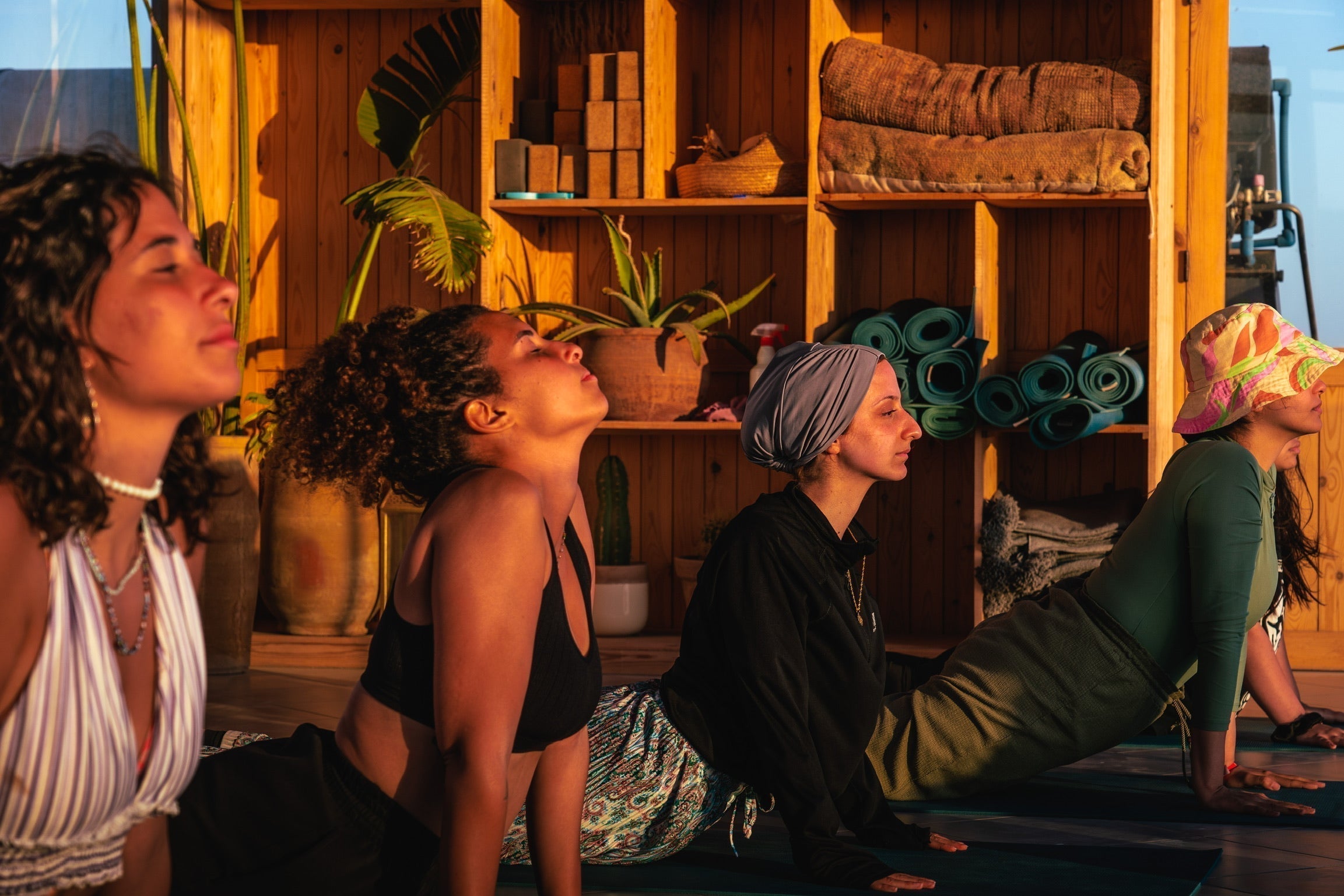
If you walk into almost any yoga studio today you’ll find the same scenario. Wall-long mirrors, quiet playlists, Lululemon leggings. Most yoga now focuses on how flexible you can be. Toning the abs. And an Instagram story aesthetic next to a plastic cup of Matcha.
Nobody likes matcha.
…Okay some do, but the vast majority doesn’t.
What you’re far less likely to find is a deep engagement with the spiritual philosophical roots behind yoga and spirituality. And these roots are unmistakably South Asian.
Now this transformation didn’t happen overnight. It is a result of years of translation, adaptation, commercialization… you know, the famous trio of colonialism, globalization, and capitalism.
Yoga Before The Money
Yoga didn’t begin as a physical exercise. It started in Ancient India as a spiritual and philosophical system based on Hindu traditions. Yoga in its essence is a philosophy of self-realization and liberation. Its goal was not physical fitness. Its goal was to live ethically, transcend the ego, and find this union between the individual self and the divine.
In fact, the poses (Asanas) are just one small part of a much larger system of ethics, morals, self-restraint, meditation, and liberation. A code of living.
What is widely understood as yoga nowadays is only part of traditional yoga. Traditionally, yoga practice consists of different parts, such as the “asana (postures), pranayama (breath control),[...] dhyana (meditation)[...] yama (observations), niyama (abstentions), pratyahara (abstraction), dharana (concentration), and samadhi (enlightenment as a state of being)”
Buut, yoga is often reduced to what we know it as in the mainstream: Poses.
So as many South Asian critics point out: modern yoga didn’t remove the spiritual layer. It simply stopped teaching it.
If you di practice yoga and just feel this rush of: Why don’t I feel anything in this pose? Or, Is this really it? I thought yoga would be something more.
Then congratulations. You’re on the right track!
Swami Vivekananda
How did yoga even reach the West? Back in 1893, Swami Vivekananda spoke at the Parliament of the World’s Religions in Chicago. His opening “Sisters and brothers of America” became iconic.

Vivekananda is credited as one of the first figures to introduce Hindu philosophy and yoga to American audiences. What he presented to the audience was the intellectual and philosophical that yoga was originally based on.
- The Vedanta philosophy.
- Meditation and Inner realization
- Universality of spiritual truth
And ironically, his presentation of Hindu ideas were adapted to make it more digestible to Western audiences. He reframed it as a universal practice.
You can listen to the English enactment of his speech here:
The Fable of Wellness
A yoga spread throughout the 20th century, it began to merge with Western physical culture. It got rebranded as a wellness activity. (which is true to some sense)
Today:
- Yoga is a multi-billion dollar global industry.
- The practice is often secularized and aestheticized.
- Marketed as a 1 class a week lifestyle rather than a philosophy.
This shift is basically the commodification of yoga. Taking the practice, stripping it of its meaning, and marketing it for profit. Turning an intangible philosophical cultural phenomenon into a commercial object.
What’s even funnier is that the yoga that is popular with the Indian youth back in India, is the westernized and commercialized yoga.
a traditional cultural expression has been taken from its culture of origin, modified to a consumer standard, and detached from its philosophical roots and fed back into the culture it was originally derived from
Nobody Is Gatekeeping Yoga
Now it is entirely false to criticise the spread of phenomenon while also gatekeeping it from the people. That is not the point.
The verdict here is not to strip away yoga from all those who practice it because they do not come from South Asian backgrounds. Yoga is for everyone.
The issue is how it is practiced and represented.. and quite frankly respecting those who made it accessible for us.
Reclaiming yoga means:
- Acknowledging its South Asian roots
- Engaging with it philosophy, not just poses
- Giving credit where credit is due
- And creating space for the South Asian voices in the industry
Yoga was never meant to be just a workout. It is a transformational path inwards.
Yoga always had a universal dimension. Even Vivekananda himself spoke about its relevance to of humanity.
SO practice yoga ethically. Don’t enable those who sell you polyester leggings for THAT much money when you can go with your regular cotton pants. Get over your ego and the “likes” worthy pics and look inside. Beneath the surface and the shallowness of appeasing strangers online.
Yoga is a beautiful spiritual practice with a lot of depth. Its roots is still intact and it is waiting for those to fully appreciate its philosophy and universal message.
For further reading
Know more about Hindu philosophy and how to make yoga more inclusive.

