

On May 30, 2026, something strangely new happened upon one of the most photographed monuments on Earth. The Huanghuacheng Lakeside stretch of the Great Wall, the only section where the ancient stones slip into water, stopped being a tourist backdrop and became for one long day, an open-air yoga studio.
Lululemon had come to Beijing to mark ten years in mainland China, and it wanted the moment to feel unforgettable.
More than 2,000 people showed up for a yoga festival on the Great Wall of China that was meant as a celebration of local culture and wellness. Global and local ambassadors — Ryan Leier, Ryan Mannix, Mary Taylor among them — passed the day leading roughly twenty different sessions as the event ran from sunrise to nightfall.
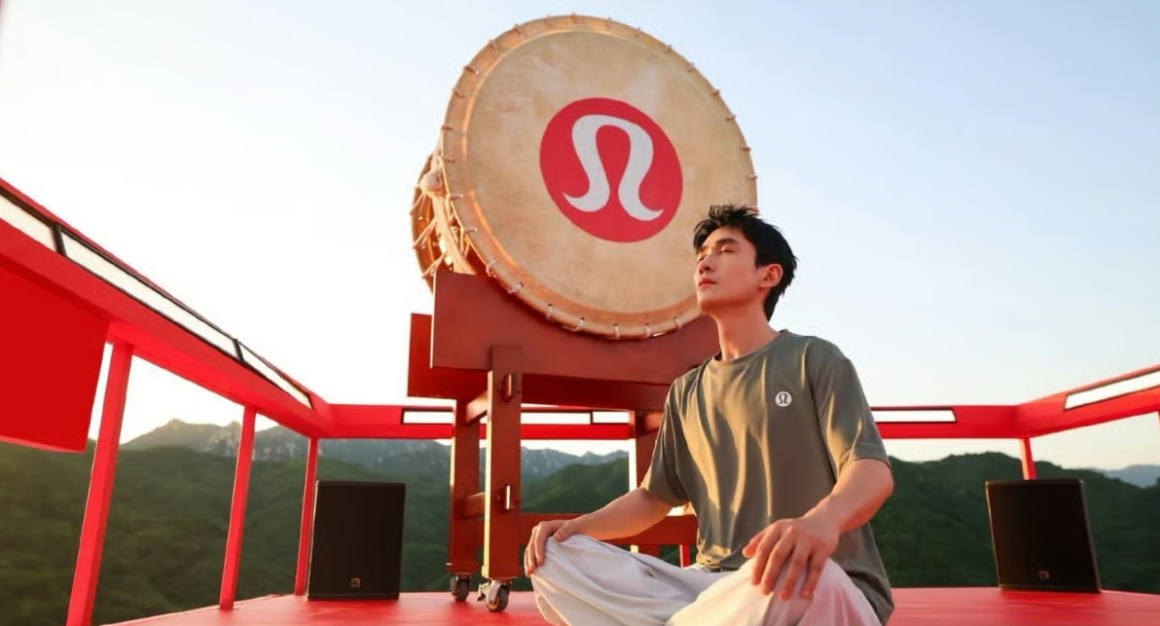
Not only did Lululemon stop at mere yoga activations, but the Shenzhen Opera and Dance Theater performed excerpts from the acclaimed dance drama "Wing Chun," blending martial arts with yoga flow. Followed by an iconic spectacle around the golden hour of sunset, where actor Zhu Yilong joined the HiiKo drum troupe to beat traditional Chinese drums, followed by 200+ participants doing specially designed "Tai Chi fusion yoga" on the wall itself.

Needless to say, there was real care put into how the festival treated the site. Every structure was removable, built under a "minimal intervention, maximum respect" philosophy, and volunteers from local Great Wall conservation stations were on-hand throughout the day to talk about preservation.
Lululemon also made a donation to a Chinese cultural heritage foundation to support ongoing conservation work in the area. An attempt, it seemed, to honor the ground it was standing on rather than simply borrow its scenery.
For a few days, everybody was super impressed by this marketing campaign. A foreign brand had pulled off one of the most striking wellness activations anyone had seen, uniting global ambassadors and thousands of local practitioners on a UNESCO World Heritage Site to celebrate a decade of growth in China.

Lululemon's own executives called it a defining moment. The "crazy idea" that a small team in China had somehow turned into reality. And a possible opening act of a bigger summer of similar activations planned across North America, Europe, and Asia.
Yet the part that got the most heightened media attention was not this well-executed event, but rather a miscalculation. An overlooked tiny teeny detail. Buried inside the many elements included within the cultural performance led by the actor Zhu Yilong, the used drums were actually Japanese in origin... not Chinese.
The drums were meant to be a small artistic flourish, nothing serious. But it accidently collided with something the brand's marketing team apparently hadn't fully recognized: The depth of anti-Japanese sentiment in China, based in historical wounds that are still very much alive in public memory.
Here you'd say: But I'm not interested in politics. I just like Lululemon matching sets and I have a guilty obsession with binge eating steamed dumplings at 3 am.
Well, politics surround us whether we like it or not. And Lululemon had to address their overlook of this specific turn-of-head regarding politics whether it was intentional or simply accidental.
Lululemon responded quickly. It posted an apology on its official Weibo account, acknowledging that it hadn't fully anticipated the sensitivities involved and that the performance should have been reviewed with far more care. It apologized to its ambassadors and to the public, promised to learn from the mistake, and quietly pulled all of the festival's promotional content. The drum troupe itself apologized too, and reportedly retired the specific instrument from its collection.
It's a strange kind of irony, really. A brand trying to honor a decade of connection to a market, staging its biggest most sincere gesture yet, and getting tripped up not by the scale of its ambition but by a single detail nobody in the room thought hard enough about.
Marketing analysts have pointed out that Lululemon isn't alone here either. Other global brands have stumbled over similar cultural insensitivities not only in China recently but globally, each time in ways that seemed obvious only in hindsight.

A Pattern That Is Difficult to Keep Dismissing
Here is when I started to notice a pattern.
Obvious? Not quite.
Unintentional? Maybe..?
Redundant? Most Definitely.
The pattern does as follows.
A Western brand moves into a new market. Stages an incredible culturally celebratory event meant to bridge the differences between two contrasting societies. Beautiful scenery. Amazing execution.
Yet there exists a probability. A probable chance of something that might get lost in translation. Like a joke or a proverb that doesn't really translate nicely from Russian to say... Swahili.
Later on, the brand owns up to its mistake, apologies, and we all move on. While somewhere else, on the other side of the globe, a different brand in an entirely different context is in the middle of this exact same process.
Yet what makes it so genuinely hard to keep reading these as isolated incidents and not link them to a broader pattern us how consistent the underlying shape of each one of these incidents is. Even as the brands, markets, times, and specific cultural references keep changing.
For example, Dolce Gabbana released a racist ad when targeting China, outdoor apparel Arc'teryx (that is local to its region) blew firework upon sacred environmentally protected Tibetan land, design references by Ralph Lauren at Paris fashion Week went uncredited to their South Asian origins, and an unnoticed yet noticed "Air" logo upon Nike sneakers that closely resembled the Arabic word for Allah.
All these contexts are starkly different but the gap at the center of each story is almost always remarkably the same. And that gap, fuels the pattern.
The Issue Is in the Sequence, Not the Intention
One of the things that tends to get lost in the noise around these stories is that most of these brands are genuinely not acting out of disregard, and it's worth being clear about that because treating every incident as a story about bad intentions actually makes it harder to understand why the pattern keeps recurring.
Lululemon clearly poured real effort and thought into the Great Wall event — the conservation philosophy, the heritage donation, the local collaborators — none of that reads as a brand that didn't care about getting it right. In fact, just a few days after the Great Wall of China activation, they executed another one that harbored immense unprecedented success. Along Shanghai's North Bund, nearly 1,300 participants gathered along the Huangpu River for a full day of communal yoga practice.

As night fell, lululemon unveiled a large-scale light show inspired by its community collectives, and built around the themes of "breathe", "stretch" and "flow". The projections lit up several landmark structures along the skyline including the Shanghai Oriental Pearl TV Tower.

What seems to happen is that market ambitions get mapped out first, creative direction follows, and cultural fluency ends up being something added toward the end of the process rather than something the work is built on from the beginning.
And that's a different thing from having people who have that cultural knowledge present early enough to shape the ideas while they're still being formed, rather than reviewing them once they're already locked and approved. By the time most of these campaigns reach the public, the decisions that defined them were made weeks earlier in conversations that have long since wrapped up.
Having a Local Presence Is Not the Same as Having Local Understanding
The Arc'teryx story is worth including here because it complicates even the most straightforward answer of what the pattern break might look like.
Arc'teryx is Chinese-owned which should mean that the brand has closer proximity to the kind of cultural context that Western-headquartered brands often lack.
Yet, the brand staged a huge fireworks show called "Rising Dragon" on the Tibetan plateau. A landscape that holds deep significance in Tibetan Buddhist tradition.
The response from both environmental and cultural observers raised questions the brand clearly hadn't anticipated but could have predicted if only they had sourced the "correct" local people.

The Fireworks spectacle done by Arc'teryx in the Tibetan Plateau.
The point isn't to single out Arc'teryx as an enemy.
It's to show that ownership or regional presence doesn't automatically mean that cultural authority exists within the creative process where it would actually be useful.
It raises an interesting question about what "local" actually means in the context of these campaigns, and whether the industry has a clear answer to it yet.
What Actually Changes the Pattern
None of this requires brands to stop expanding into new markets. And none of it is an argument against drawing creative inspiration from cultures outside one's own.
Cross-cultural appreciation has always been part of how fashion, music, and design evolve and that isn't going to change nor should it. As the most beautiful of complexities and merge of cultures happens when this is done well.
The real question is simpler than it sounds: who's actually being consulted, and when?
Too often, cultural input gets treated as a final check.
This isn't a case where there's no clear answer.
There is one: bring in the right people, with the right expertise, early enough that they can actually shape the idea, not just approve it on the way out the door.
What does seem true across these cases is that the brands most likely to navigate this well are probably the ones treating cultural knowledge as something that belongs inside the creative process from the beginning.
Not as a layer added to a concept that was already decided, but as part of how the concept gets shaped in the first place.


