

If you step into the contemporary wellness arena, you will likely find yourself surrounded by a familiar vocabulary: alignment, flow, detox, manifestation, mindfulness, and balance.
And let's be entirely honest for a moment: modern self-care can be absolutely exhausting.
If you scroll through social media on any given Sunday, you’re bombarded with a very specific, highly aesthetic brand of "wellness." It’s a world of $18 green juices, color-coordinated beige meditation rooms, and influencers telling you to "manifest your destiny" while contorting into poses that look structurally impossible.
But if you scratch beneath that beautifully filtered surface, a lot of us feel a lingering sense of fragmentation. We are anxious, disconnected from our communities, and burnt out on the very routines meant to fix us.
In ancient Egypt, they had a specific word for this chaotic, out-of-whack energy: isfet. And right now, isfet is running the wellness industry.
Isfet is the ancient Egyptian concept of chaos, imbalance, and fragmentation.
And this is precisely why an increasing number of wellness practitioners are throwing out the modern capitalistic wellness and looking backwards in history (about 5,000 years backwards) imitating the way archaic human communities practiced wellness and justified it to lead a balanced life.
This trend is not simply an alternative to the highly optimized wellness we're used to, but a direct response to it. We are told to fix our sleep, (enter sleepmaxxing) optimize our lives, and retreat into isolated bubbles of self-soothing that completely detaches us from the communities we live in and the world we occupy. But now, we are reviving the ultimate ancient blue print for wellness: Ma'at.

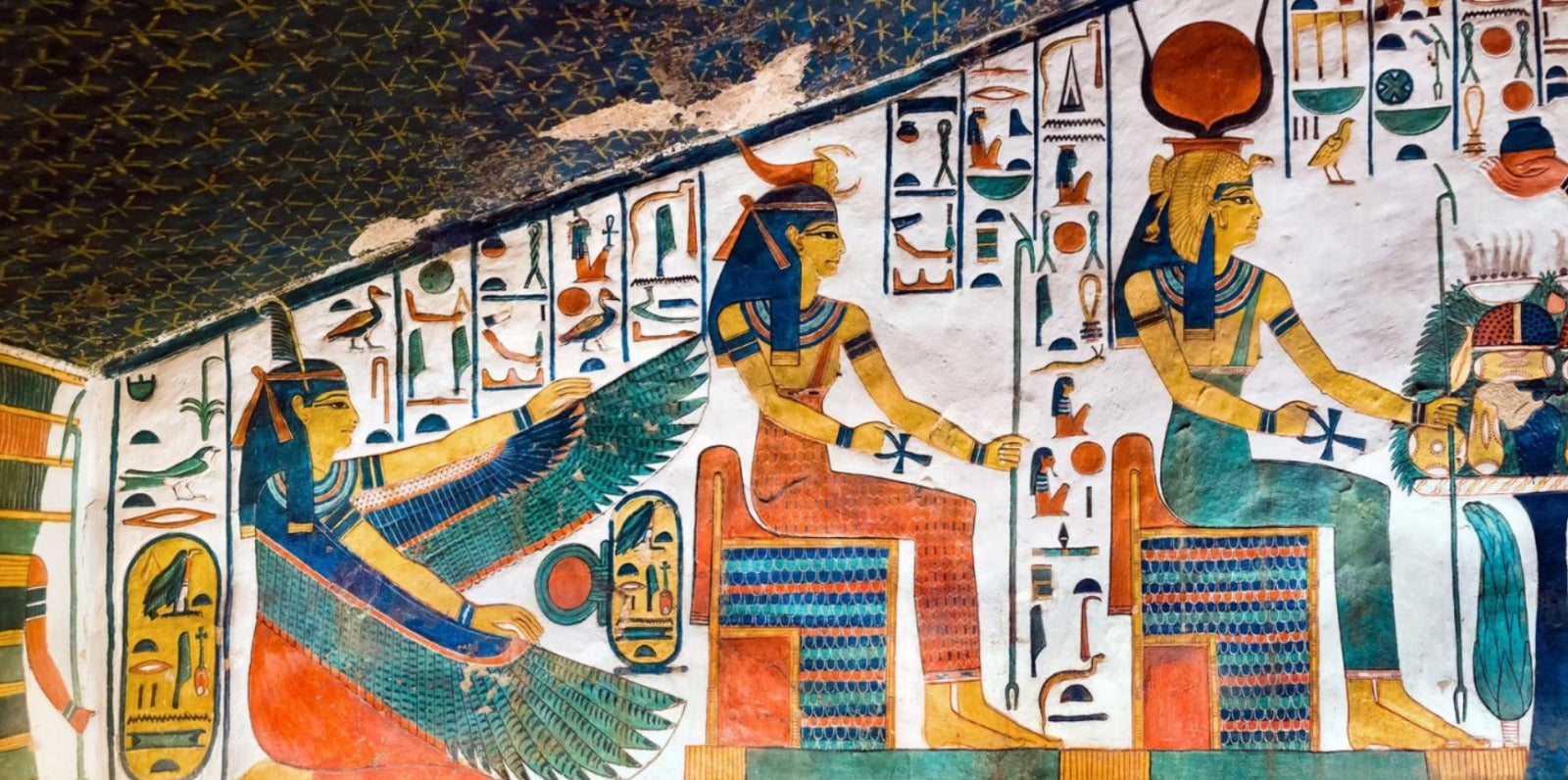
Kneeling figure of Ma'at with outspread wings in the tomb of Pharaoh Seti I of the Nineteenth Dynasty
Who is Ma'at?
To the ancient Egyptians, Ma’at wasn't a luxury spa day or a phase you went through after a bad breakup. It was the literal cosmic glue holding the universe together. It represented truth, justice, harmony, balance, and cosmic order.
Today, a growing movement of yoga teachers, and wellness leaders in general are centering Ma’at as their foundational code. By doing so, they are transforming wellness from an aesthetic into an ethics-driven way of life.
To bring Ma’at into a modern studio or therapy room, instructors first have to translate an abstract ancient concept into everyday life. Similar to have one must translate Sanskrit in Yoga to fully understand its foundations.
In ancient hieroglyphs, ma't comes from a root word meaning "that which is straight" or "to be just." Picture a perfectly leveled surface or a straight line. When the Egyptians personified this idea, they drew a goddess wearing a single, flawlessly symmetrical ostrich feather on her head.

Ma'at in the tomb of Queen Nefertari
When a modern instructor uses Ma’at as a guiding principle, they discard the idea that health is merely the absence of physical disease. Instead, they teach that wellness is the active, rhythmic integration of seven core therapeutic principles across the physical, mental, social, and ecological dimensions of life.
- Truth
- Justice
- Balance
- Harmony
- Order
- Reciprocity
- Righteousness
Which completely changes the way one engages in their internal monolouge of self reflection.
Instead of waking up stressed and asking, "How do I escape my life today?" a Ma'at-centered approach asks: "Where has my inner scales tipped, and how do I bring things back to center?" Deep. I know.
Th Hall of Two Truths
Speaking of scales tipping, it is time you understand how Ma'at was depicted in ancient Egyptian mythology and what that meant in what she represented.
Similar to the idea of judgment day, ancient Egyptians believed that your actions within your life ultimately decides your fate in the afterlife.
This hall of two truths wasn't just a physical room. It was the underworld courtroom of the Duat (the afterlife) where every single human soul had to stand trial before they could be qualified for paradise.
The name "Two Truths" is a beautiful piece of ancient psychology. It represents a total spiritual calibration. On one side of the room, you have the grand, objective, unshakeable reality of the universe. On the other side, you have the raw, internal reality of how you actually chose to live your life.
And the ancient Egyptians visualized this cosmic trial in breathtaking, cinematic detail.

This detailed scene, from the Papyrus of Hunefer (c. 1275 BC), shows the scribe Hunefer's heart being weighed on the scale of Maat against the feather of truth, by the jackal-headed Anubis. The ibis-headed Thoth, scribe of the gods, records the result. If his heart equals exactly the weight of the feather, Hunefer is allowed to pass into the afterlife. If not, he is eaten by the waiting chimeric devouring creature Ammit composed of the deadly crocodile, lion, and hippopotamus.
The Three Phases of the Ultimate Trial
When your soul arrived at the gates of the Hall, you had to go through a rigorous, highly dramatic three-step process:
Step 1: The Negative Confession:
The moment you step into the massive hall, you are met by a staggering sight: Osiris, the Lord of the Underworld, sits on his throne, flanked by a panel of 42 divine judges. Each of these terrifying judges represents a different region of Egypt or a very specific type of human flaw. You had to look these cosmic entities in the eye and read off a list of things you didn't do wrong. You had to declare things like: "I have not stolen," "I have not told lies to make people sad," or "I have not polluted the life-giving waters of the Nile."
Step 2: The Weighing of the Heart
Here is the catch: words are cheap, and the gods know it. You could try to smooth-talk your way through the confessions, but the Egyptians built a flawless that reveals all this true and all that is false. A massive set of golden balance scales sit right in the center of the room. On the left pan, the jackal-headed god Anubis places your heart (Ib). To the Egyptians, your heart was the most important organ of your body that records every single action, secret thought, and emotion you ever had. On the right pan, Anubis places the Feather of Ma'at. A perfectly symmetrical ostrich feather representing cosmic truth and absolute purity.
Step 3: The Recording of the Verdict
As the golden scales swing back and forth, creaking under the weight of your soul, the ibis-headed god Thoth (the divine scribe of heaven) stands ready with a reed pen and a papyrus scroll, carefully measuring the exact balance and recording the unalterable, final verdict for the cosmic archives.
If your heart was weighed down by greed, deceit, cruelty, or untreated ego, the scales would tip. The heart would sink, proving you lived a life of isfet. At that exact moment, a bizarre, terrifying creature named Ammit (part crocodile, part lion, part hippopotamus) who sits waiting at the base of the scales would leap forward and devour your heart instantly. You would suffer the "Second Death"—complete erasure from cosmic existence. No afterlife, no reincarnation, no memory. Just total non-existence.
But if your heart was completely weightless, balancing in perfect, flawless equilibrium with the feather of truth, Thoth would proudly declare you ma'a-kheru—meaning "true of voice." Osiris would smile, open his arms, and grant you an all-access pass to the Field of Reeds (Aaru), a gorgeous, celestial paradise free from pain, hunger, or sadness... kinda like heaven.

Sennedjem and Iineferti in the Fields of Iaru (Field of Reeds)
Why Modern Wellness Instructors are Obsessed with this Image
When you look at this ancient trial through the lens of modern lifestyle design, it stops being a spooky old myth and becomes a brilliant psychological metaphor for auditing your life.
The goal of modern Ma'at-centered wellness isn't to live a flawless, rigid, sin-free life. It's to live a life of alignment. It's about making sure that the energy you put out matches the energy you take in. That your daily schedule reflects your deep internal values. That you aren't carrying around the heavy toxic weight of things that don't belong to your true nature.
In simple terms, you don't have to wait until you die to weigh your heart. Every time you slow down, sit in meditation, or step onto a yoga mat, you are checking the scales.
If you’re tired of the hyper-optimized wellness and want to discover more of why the wellness is industry is the way it is, join our community and have exclusive stories, private retreat openings, and 48 Hour Frenzy rates delivered straight into your inbox.


