

In a world that demands constant connectivity, there is a rare luxury in choosing to disappear. In choosing to disconnect.
While people claim that the Nile is best discovered through the towering decks of massive cruise ships, airconditioned cabins with endless food options on your daily buffet spread, there exists a more ancient and rhythmic way to traverse Egypt's lifeline.

The gentle rhythm of the Nile, slowly gliding over it. A river that had seen civilizations rise and fall. A river that has seen the First Men cultivate their first plant and sow the world's first sign of humanity.
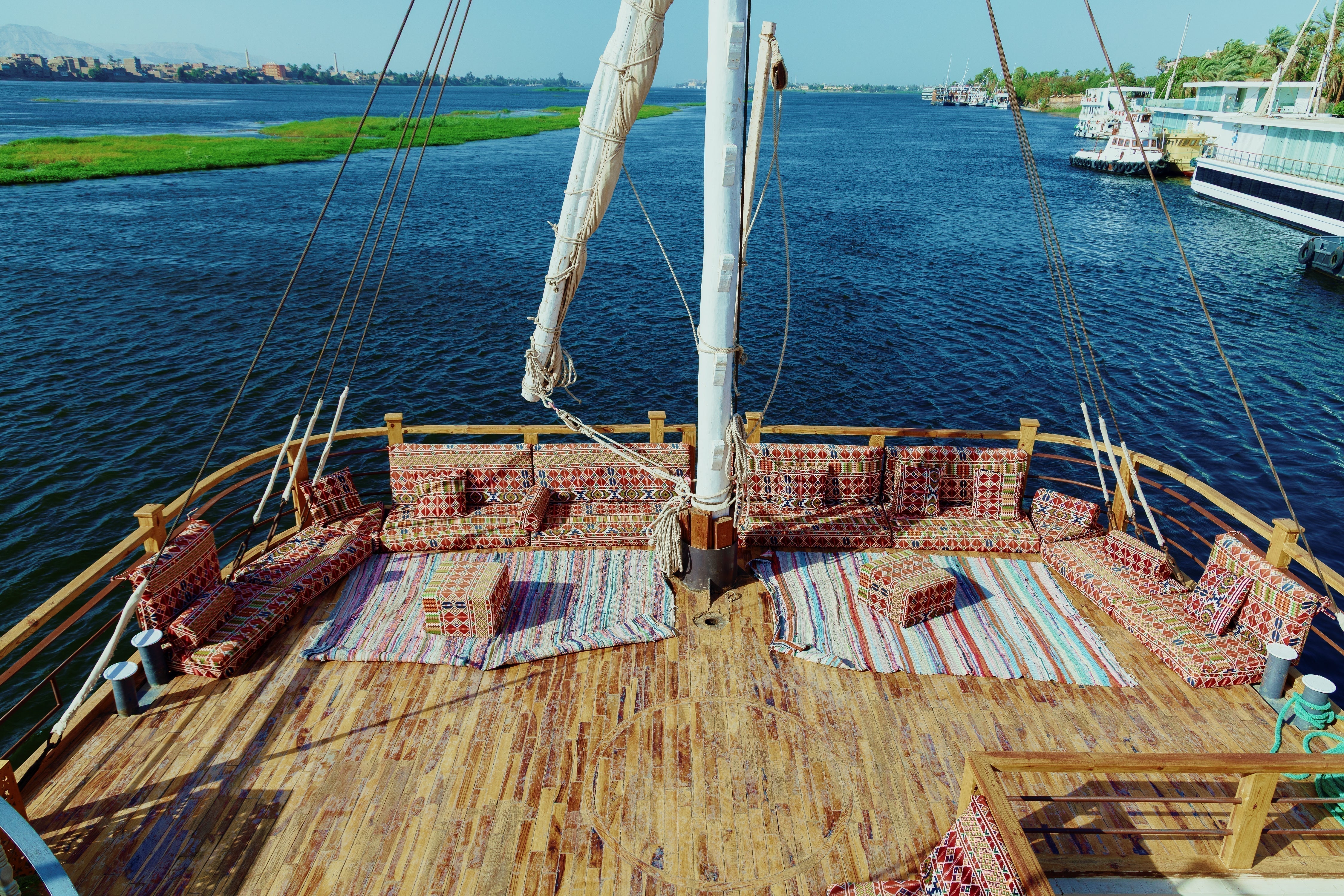
Constructed from warm woods and adorned with hand-woven Egyptian linens, this vessel is designed to feel less like a hotel and more like a private residence, imitating the way ancient Egyptian used to travel across the stream of the Nile.
With only a handful of cabins, the experience is defined by what is missing: there are no engines.

Enter... El Nur.
Arabic for "The Light," El Nur is not just a boat; it is a hand-drawn dream, a floating sanctuary built from four tons of iron and finished entirely in wood.
It is the contrast of the modern cruise. A vessel designed by listening to the river for twenty years before a single piece of timber was laid.
A Dahabiya—the golden one—is a traditional twin-masted sailing boat that harkens back to the 19th century, when royalty and aristocrats spent weeks drifting between Luxor and Aswan.
El Nur isn’t just a vessel; it is a masterclass in the luxury of intentionality.
Standard luxury is often about more, but here, luxury is simplicity.
It’s the taste of sun-ripened tomatoes, freshly baked aish baladi bread, and the deep earthy aroma of hibiscus tea served as the sky turns a bruised purple at twilight.

The story of El Nur is one of radical intentionality.
While many modern "dahabiyas" are essentially small cruise ships disguised with sails, El Nur was birthed in the traditional boatyards of the Delta.
Its co-founder, Sayed, didn’t just commission the boat; he lived the construction, overseeing every epoxy application and rust-protection coat.
Step on board, and you won’t find room numbers. In a move that honors the spiritual heritage of the land, each cabin is named after one of the Names of God.
Every lamp is handcrafted. Every door handle was chosen for how it feels beneath the palm. Every fabric was selected to breathe with the Egyptian heat.
This is no longer an ordinary hotel on water. It's a home that floats.

Perhaps more importantly, El Nur is the only vessel of its kind to hold a National Environmental Certification.
With solar panels already lining the deck and a goal to be fully solar-powered within two years, the luxury here isn’t just about what you receive, but what you leave behind.
This is a boat that not only sails the Nile sustainably, it works to clean and restore it.
On the sun deck, under the shade of heavy canvas sails, time stretches.
You aren't just passing through a landscape; you are participating in it.
You are eating food sourced from the very riverbanks you are passing, prepared by a crew that is treated with the dignity of family.
You are moving through the cradle of civilization with humility and awareness.

We live in an age of "fast" everything. Fast food, fast fashion, fast travel.
El Nur is the antidote.
It is a reminder that the most profound way to experience the majesty of the Nile is to move at the speed of the wind.
It is a vessel for light, both in name and in spirit. For those who wish to answer the call and see Egypt not as a checklist of monuments, but as a living, breathing soul, El Nur is waiting.
It is, quite simply, the most authentic way to find your way home on the water.
Join our list and be the first to catch our exclusive trips before they reach the public, hosted on this very deck.


